Wednesday, April 05, 2006

Calling the Darkness Light

One of my favorite passages of Scripture is Isaiah 5:20:
"Woe to you that call evil good, and good evil: that put darkness for light, and light for darkness: that put bitter for sweet, and sweet for bitter."

It immediately came to mind when I saw this story.

Beware of the book, "Conversations with God."

Saturday, April 01, 2006

If you have children or grand-children or you have neighbor children whose parents you know, please take note of the info below or pass it along to others. Schools are a distribution point to children for this book through the Scholastic Book Club. Beware of the book, "Conversations with God." Dr. James Dobson talked about this book twice this week. It is devastating - and parents and Christian schools need to be aware of this. Do pass it on to church/e-mail addressees, Parents, Grandparents, Aunts, Uncles, Cousins, friends.

Please pay special attention not only to what your kids watch on TV and in movie theaters and the music they listen to, but we must also be alert regarding the books they read. Two particular books, "Conversations with God" and "Conversations with God for Teens," written by Neale D. Walsch, sound harmless enough by their titles alone. These books have been on the New York Times best sellers list for a number of weeks, and these publications make truth of the statement, "Don't judge a book by its cover/title."

The author purports to answer various questions from kids using the "voice of God". However, the "answers" that he gives are not Bible-based and go against the very infallible word of God. For instance (and I paraphrase), when a girl asks the question "Why am I a lesbian?" His answer is that she was born that way because of genetics (just as you were born right-handed, with blue eyes, etc.). Then he tells her to go out and "celebrate" her differences.

Another girl poses the question "I am living with my boyfriend. My parents say that I should marry him because I am living in sin. Should I marry him?" His reply is, "Who are you sinning against? Not me, because you have done nothing wrong." Another question asks about God's forgiveness of sin. His reply "I do not forgive anyone because there is nothing to forgive. There is no such thing as right or wrong and that is what I have been trying to tell everyone, do not judge people. People have chosen to judge one another and this is wrong, because the rule is "'judge not lest ye be judged.'"

And the list goes on. Not only are these books the false doctrine of devils, but in some instances even quote (in error) the Word of God. These books (and others like it) are being sold to school children (The Scholastic Book Club), and we need to be aware of what is being fed to our children. Our children are under attack. So I pray that you be sober and vigilant about teaching your children the Word of God, and guarding their exposure to worldly mediums, because our adversary, the Devil, roams about as a roaring lion seeking whom he may devour (1 Peter 5:8). And how many of us know that lions usually hunt for the slowest, and weakest and YOUNGEST of its prey.

Pass this on to every Believer you know. God bless! And, if in doubt, look at the books yourself.


What's in a Word

Bouleversement
Complete overthrow; a reversal; a turning upside down.

"It requires a complete bouleversement in your whole attitude, a process of adjustment that anyone who's been in this position understands; but you need to go through it."

Tuesday, April 04, 2006

Adventures in Cloning

This Just In

Did you ever read anything so stupid in your entire life?

Jesus Could Have Walked on Ice, Scientist Says
By Sara Goudarzi
LiveScience Staff Writer
posted: 04 April 2006
12:03 pm ET


Rare conditions could have conspired to create hard-to-see ice on the Sea of Galilee that a person could have walked on back when Jesus is said to have walked on water, a scientist said today.

The study, which examines a combination of favorable water and environmental conditions, proposes that Jesus could have walked on an isolated patch of floating ice on what is now known as Lake Kinneret in northern Israel.

Looking at temperature records of the Mediterranean Sea surface and using analytical ice and statistical models, scientists considered a small section of the cold freshwater surface of the lake. The area studied, about 10,000 square feet, was near salty springs that empty into it.

The results suggest temperatures dropped to 25 degrees Fahrenheit (-4 degrees Celsius) during one of the two cold periods 2,500 –1,500 years ago for up to two days, the same decades during which Jesus lived.

With such conditions, a floating patch of ice could develop above the plumes resulting from the salty springs along the lake's western shore in Tabgha. Tabgha is the town where many archeological findings related to Jesus have been found.

"We simply explain that unique freezing processes probably happened in that region only a handful of times during the last 12,000 years," said Doron Nof, a Florida State University Professor of Oceanography. "We leave to others the question of whether or not our research explains the biblical account."

Nof figures that in the last 120 centuries, the odds of such conditions on the low latitude Lake Kinneret are most likely 1-in-1,000. But during the time period when Jesus lived, such “spring ice” may have formed once every 30 to 60 years.

Such floating ice in the unfrozen waters of the lake would be hard to spot, especially if rain had smoothed its surface.

"In today's climate, the chance of springs ice forming in northern Israel is effectively zero, or about once in more than 10,000 years," Nof said.

The findings are detailed in the April 2006 Journal of Paleolimnology.

Sunday, April 02, 2006

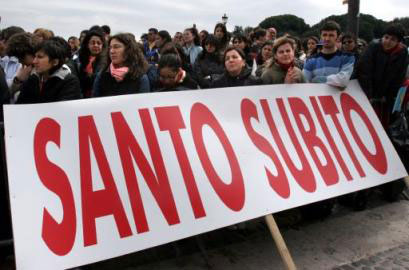
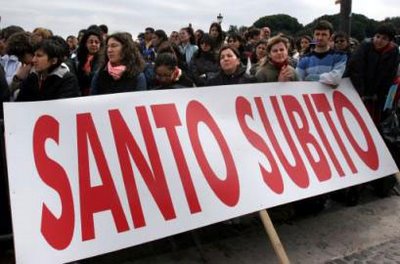
Santo Subito!

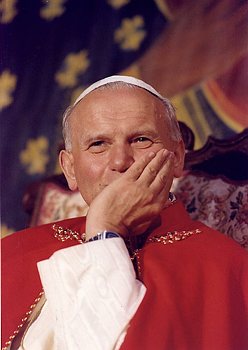
Here is an editorial from National Review last year regarding John Paul II (the Great).


John Paul II, R. I. P.

Many of his admirers say that he will be remembered as John Paul the Great, and hope that he will be canonized. The case for his greatness begins with his witness against the totalitarianisms that disfigured his country and the last century. Karol Wojtyla saw that Communism, like Nazism, was both evil and doomed to fail. Its error was not fundamentally economic but anthropological. Its view of human beings was false. The individual person was more than "an element, a molecule within the social organism," and had a longing for truth, for transcendent meaning, that tyranny could not erase.

What followed was the priority of culture over economics and politics. Pope John Paul II fought the Soviets by helping people reclaim their dignity. To escape from evil regimes, central Europeans first had to escape from those regimes' lies. Those regimes claimed to be all-powerful and to be the final arbiters of truth. Exposing those pretensions was a precondition for their demise. The Church's power was no longer the power of a state; it was the power of persuasion.

There is a tendency, in some quarters, to separate this papacy into halves: a first half in which the Pope stood for freedom against tyranny, and a second in which he tried to impose his "authoritarian" views on the Free World. But no such separation is possible: The Pope consistently fought for the dignity of the human person against the many threats to it — even threats that falsely bore the name of freedom.

That fight led the Pope into a deeper and deeper engagement with liberal modernity. Many Catholics had worried that democracy carried within it the seeds of moral relativism. This Pope saw that democracy had a solid foundation in the dignity of man, and that relativism undermined this foundation. Under him, the Church became ever more firmly committed to democracy as a political ideal — and Catholic countries led the democratic wave that spread around the world. The Church increased its appreciation of the contribution that free markets could make to human dignity. Its commitment to human rights, and especially religious liberty, also grew, and the Pope invited believers in other faiths to an ecumenism based on a shared search for the truth rather than the blurring of differences. He both reached out in friendship to the Jewish people and acknowledged the shameful past mistreatment of Jews by Christians.

“He fought for the dignity
of the human person against
the many threats to it — even
threats that falsely bore
the name of freedom.”

This most philosophical of popes even ventured to vindicate reason itself against the claims of postmodernists. The world had lost its faith in reason, he argued, because reason had been arbitrarily truncated. A reason that was not allowed to direct itself toward the highest things — to inquire about the good for man, for example — would turn on itself and come to doubt its ability to reach the truth. Voltaire would be astonished to see a Catholic Church become a steadfast defender of reason and democracy.

This Pope's mission was neither to embrace nor to reject modernity, but to rescue it. His primary responsibility was not to manage the Church as an organization. It was to lead the Church as a spiritual force. Billions of people witnessed his witness.

He was not perfect, nor did he claim to be. While he inspired many impressive and faithful young men and women to join the priesthood and religious orders, some of his appointments were disappointing. He did not appear to appreciate the extent and gravity of the sex-abuse scandals. Perhaps he was unable to fathom that a priest, let alone many priests, would act so abominably. Here the Pope, so often criticized for alleged heavy-handedness, failed in not playing to type. The Church's doctrine on war and peace did not develop as far, or as well, as its doctrine in other areas, and its diplomacy suffered as a result. It teaches that war, to be just, must be a "last resort." But surely the practical import of that teaching must change in a world where weapons of mass destruction are proliferating.

It was not doctrine, however, that made the world love Pope John Paul II. It was, above all, the personal holiness and sanctity that fairly radiated from him. Perhaps the reason he stepped up the pace of canonizations was to renew the universal call to sainthood — to show us that saints are always among us. His example helped to teach the lesson. We knew that he loved us, and we knew that he loved us because he knew that the Lord loved us.

His final word, reportedly, was "Amen." George Weigel, the author of the best biography of the Pope, often notes that John Paul II regarded Jesus Christ as the answer to the question that is every human life. His own life shows that a life can be not only a question, but a prayer. — The Editors

NOTE: This editorial appears in the April 25, 2005, issue of National Review.


John Paul the Great
What the 12 million know--and I found out too.

Peggy Noonan
Friday, August 2, 2002 12:01 a.m.


The pope's trip to the Americas has ended in Mexico with the canonization of the fabled Juan Diego of Guadalupe, the 464th saint recognized by the church since John Paul's papacy began. The pontiff has now recognized more saints than all his predecessors combined. His readiness to canonize is in service of an eagerness to evangelize. This is John Paul's desire: To raise up from as many nationalities, ethnic groups and indigenous peoples as possible a saint who is of them, from them and yet an exemplar of the universal church.

Keep the base and build the base.

Twelve million people lined the streets of Mexico City to greet John Paul the day he arrived--12 million! The church may have suffered in the field this year, but the troops apparently remain.

What did his trip accomplish? Something big. He proved that no matter how healthy or capable-seeming the pope is or is not, he is here, he is loved, he has power, he is a presence. The trip was a reply to those within and without the church who have called for the pope's resignation or retirement. John Paul said, through his actions, God decides when a pope "resigns"; God will take the pope from the earth, and as long as God keeps the pope here, the pope will fill the shoes of the Fisherman and do the work of the Lord.

I don't think we'll be hearing any more calls for the pontiff's departure any time soon.

By presenting the fact of his presence, the pope demonstrated not his personal power but the enduring power of the papacy itself, and of the church, too, come hell or high water, come scandal or shame.

On the streets of Mexico City they sobbed as he went by. Did you see it on the news? The pope was in the glass-enclosed popemobile, and as he passed, the people who jammed the streets and sidewalks reached out to him with their hands and burst into tears and sobs.

The pope they were reaching for, of course, was not the sturdy, charismatic man in white who had wowed the crowds on his first trip to Mexico as pope, 23 years ago.

This man is old, a caged lion bent and spent.

And still they sobbed and reached for him.

Why?

"The force of his presence was like a blow to the heart." That's how the actor Richard Burton described meeting Winston Churchill. I thought of that after I met the pope.

It was late June 2000, and I was visiting Rome to speak to a business group. When I was invited to speak I called a friend of a friend in the New York Archdiocese and asked if I could get a ticket to an audience with the pope. She took down the number I'd be staying at and told me to stand by.

I was to be in Rome for five days, and each day I hoped a call would come. The day before I left, the phone rang in my room, and a young woman with perfectly enunciated English told me that the next morning I would see the pope. "Go to the big bronze doors of the Vatican," she said, "and wait."

That's what I wrote in my notes. No address, just big bronze doors, Vatican.

The next morning at sunrise I hailed a taxi and said in English: "The big bronze doors of the Vatican," and the driver said "OK!" as if he'd been told that destination before. We drove through silent streets. I was excited. You're supposed to get less enthusiastic about people as you get older, or at least less moved by them, and be less impressed by them, but that hasn't happened to me. And the pope was the person I most admired in the world--John Paul the Great. Writer, poet, evangelist, lover of children, comforter of the pained, inspirer of the caged and controlled, resister of fascism, defeater of communism, definer and denouncer of materialism, great foe of the culture of death. A great man of the ages, a man for all seasons and times.

We got to the big bronze doors, and I stood in front of them in the thin morning sun. I knocked. The sound of my knocking seemed tinny, almost comic against the weight of the doors. No one answered.

Soon a young man came by--early 20s, tight black jeans, tight black T-shirt, pierced earrings up and down his ears, pierced earring in his eyebrow, black spiky hair, sideburns shaved to points on the curve of his jaw. We waited silently, looked at each other and looked away. Finally I looked at my watch. "Guess they're not open yet," I said.

He nodded and said, "I'm early."

"Do you have an appointment here?"

"Yes," he said. "I'm going to see the pope."

He was from Canada, he said. He writes rock music and is an aspiring musician. He was in Rome for work and asked his bishop back home if he could see the pope.

I told him I had done the same.

Little by little they came, our motley crew. A hearty, high-colored middle-aged man with an Australian accent, in a sober black suit, his wife and teenage children. They looked like the richest Catholics in Sydney. Then a Polish family in full native costume--dirndles, braided hair, pleated white dresses and blue cotton bows. Soon there were more than a dozen of us.

Suddenly, silently the great bronze doors opened, and we were gestured in by a man in a janitor's clothes. He hustled us up the stairs, past Swiss Guards in their black-and-red uniforms. Up a series of marble stairs, to the right and up some more, then a landing from which one looked down great marble halls. Then up another floor until we were ushered into a huge and stately room of white-gray marble.

Here waiting were more people. There were about 30 of us in all now, and we lined the room standing against the walls. The room filled with excited chatter. I had stuck with my heavy-metal Canadian, and the Australians had stuck with us.

My Canadian looked at me and said, with some urgency, "What do we do when we meet him? How do you meet the pope?"

It hadn't occurred to me to think about this. I shrugged and said, like a happy American idiot, "I think you shake his hand."

"You do?" he said. "I thought you, like, kiss it, or bow."

"I don't know," I said, and turned to the Australian burgher to ask him when suddenly there was silence. Like a blanket of silence had fallen on us. And we all looked in the same direction and suddenly two great doors were opening soundlessly, and then there was a rustling noise, and we stood straight up.

And he entered. John Paul the Great. Massive and frail, full and bent--a man like frail marble. He was dressed in white robes, a white beanie on his white hair. He walked slowly, a cane in his right hand, his head tilting forward. The face expressionless--the Parkinsonian mask.

He stepped into the room and the room burst into applause.

And suddenly there was singing. It was a group of dark-haired young nuns dressed in blue. They almost levitated at the sight of him and they had burst into song. He stopped in front of them and his head went back and his chest filled. Then he took his cane and shook it at them merrily and said in a baritone that filled the room, "Philippines!"

Feel-ah-PEENZ.

And the nuns exploded with applause because they were indeed from the Philippines and he had known. They one after another knelt on the floor as he walked past.

Now he looked at another little group and he shook his cane comically as he passed them and said, "Brah-SILL!"

And the Brazilians cheered and started to cry.

And the pope moveed on, shuffling now, and he walked by an extraordinary looking young man--coal black hair, thick and cut so that it was standing straight up. It looked like Pentecost hair. He was slim, Asian, in the dress of a seminarian. He had been watching things dreamily, happily, his hands in the attitude of prayer, and then the pope stopped, turned and held his cane toward him.

"China!" he said.

And the young man slid to his knees, bent toward the floor and moved to kiss the pope's shoe.

And the pope caught him in an embrace as if to say No, I am not your hero, you are my hero.

And from nowhere came to me the electric charge of an intuition. I felt with certainty that I had just witnessed a future saint embrace a future cardinal of Beijing.

And my eyes filled with tears.

The pope proceeded down the line, nodding and patting, and when he got to me I jerked into a kind of curtsy-bow and touched his right hand with my hands. Then I bent and covered his thick old knuckles with Chanel No. 23 Red Raspberry lipstick.

I couldn't help it. I think I said, "Papa." He nodded. He was probably thinking, "Oh Lord, another lipstick leaver." And then he pressed into my hand a soft brown plastic envelope bearing an imprint of the papal seal. When I opened it later I saw light and inexpensive rosary beads, the crucifix of which carried an aluminum Christ on the cross, his broken body ungainly and without grace. It is this depiction of Christ that the pope carries at the top of his crozier, the long silver staff he uses when he walks into the world.

I still have the picture of our meeting. I never saw anyone take it and was surprised to receive it in the mail. I look gooney. Like a happy gooney woman transported by bliss.

The last person in line was the Canadian rocker. When the pope came to him, he bowed and kissed John Paul's hand. "I have written music for you," he said. He showed the pope a sheet of music, beautifully done by hand and laminated. It had a title like "A Song for John Paul II."

The pope looked at it and said, "You wrote?"

And the rocker, rocking, said, "Yes, for you."

The pope took it, walked 10 feet away to where there was a big brown table, and signed it in a big flourish--Johannes Paulus II. And came and handed it back.

And then he walked on, and out of the room.

There was silence again until it was broken softly by my rocker. "This is the greatest day of my life," he said to me. And my eyes filled with tears again because I knew it was true and because it is a privilege to be there on the best day of another human being's life.

We were ushered out and I went into the streets of Rome and in time hailed a cab and told the cab driver all about it. I was so excited I left my eyeglasses on the seat. But I still had the rosary beads, and they're here with me right now, right in front of me on my desk.

So when I saw those sobbing, reaching Mexicans I knew what they knew. When you see the pope something happens. You expect to be moved but it's bigger than that and more surprising. It feels like a gaiety brought by goodness. It feels like a bubbling up. I think some people feel humbled by some unseen gravity and others lifted by some unknown lightness.

It's like some great white dove flutters from your chest, emerges and flies upward. And you didn't even know it was there. And all this leaves you reaching outward, toward one who is broken, ungainly, without grace. And it fills you with tears. Or so it seems to me. At least that was my experience.

Ms. Noonan is a contributing editor of The Wall Street Journal. Her most recent book, "When Character Was King: A Story of Ronald Reagan," is published by Viking Penguin. You can buy it from the OpinionJournal bookstore. Her column appears Fridays.


Ms. Noonan is a contributing editor of The Wall Street Journal. Her new book, "When Character Was King: A Story of Ronald Reagan," is just out from Viking Penguin. Her column appears Fridays.

Copyright © 2006 Dow Jones & Company, Inc. All Rights Reserved.

Santo Subito!
Sainthood NOW!

Saturday, April 01, 2006

From the Gee, No Kidding Dept.

Your Hospital Stay Could Kill You
90,000 Americans Die From Hospital Infections Each Year

March 30, 2006 — - When he entered the hospital in February 2004, Mark Bennett was a vibrant 88-year-old with little more than a bad cough. Within a few days, his leg had swelled and become discolored. Within four months, he was dead.

It turns out that hospital personnel had passed on at least six different bacterial infections, inducing drug-resistant strains, to Bennett, according to his son, Michael Bennett.

"This was passed to him through negligence, and he died because of it," Bennett said. "He was gentle, yet strong, just a great human being."

Each year, more than 2 million people in the United States acquire an infection during a hospital stay, and an estimated 90,000 people die from them -- more than from AIDS, breast cancer and auto accidents combined.

"If 110 people were dying daily from the bird flu, I think we'd be calling this an epidemic," said Marc Volavaka of the Pennsylvania Health Cost Containment Council.

The danger is growing worse because many hospital-acquired infections can no longer be treated with traditional antibiotics. Experts, however, say these infections are almost always preventable.

"Infections are spread on the hands and gloves of health-care workers, on their labs and uniforms, on stethoscopes and blood pressure cuffs and bedrails," said Betsy McCaughey of the Committee to Reduce Infections.

Protect Yourself

Drs. Mehmet Oz and Michael Roizen, authors of "YOU: The Smart Patient," said that patients can protect themselves by heeding the following advice:

Clean Hands
Aggressively insist on clean hands. The rule is that everyone -- doctors, nurses, orderlies -- must wash their hands between each patient. If you don't see them do it, ask them to. Also, make sure your visitors wash their hands and have hand sanitizer available for them to use.

Hospital Accreditation
Not all hospitals are accredited, and often the hospitals that are the only game in town, don't bother with it. Hospitals that are accredited must pass an exam on cleanliness and infection control as well as on patient rights and treatment. Hospitals are cleaner and better-organized after these exams. You can find out whether the hospital is accredited by going to the joint commission Web site.

Check Hospital Ratings
A number of sites rate hospitals and provide information on diagnosis and treatment, the procedures that are performed, and how the patients fared. There are also "nurse magnet" hospitals where the best nurses work, the morale is the highest, and the hospital has the most resources. You want to be where nurses want to be.

Look for Full-Time Staff
It's crucial to know whether the hospital employees are full-time staff. Patients in hospitals without full-time staffs do not do as well.

Ask Your Doctor
Generally, good doctors are at good hospitals and many have privileges at more than one facility. If they do, do your homework and choose the right hospital for you. Another thing to do is to ask your doctor's office which hospital the doctor's family uses.

Hospital Specialties
If you have vascular problems and your doctor's hospital is known for its cancer research, it may not be the best fit. It may not be right for your problem. Once you've identified the hospital you want to use, call it and ask how many of these procedures are performed there and what the results have been.

Stay With the Patient
If your loved one is in the hospital, stay with him or her, especially overnight. It's difficult for nurses to be everywhere on the night shift so if you're with your loved one, you can get help if it's needed.

Living Will
Make sure that the hospital and all of your family know just what you want to do. Give someone power of attorney so that decisions can be made if you're incapacitated. No one wants to do it, but it's free and crucial to have in place if you're in the hospital.

Friday, March 31, 2006

Die Grosse Stille

My son told me about this movie. So, when I saw this article on Chiesa I thought I'd post it.
Everyone to the Cinema, to Listen to “The Great Silence”

The film was shot at the Grande Chartreuse in Grenoble, and is 162 minutes of pure contemplation. In Germany, it has met with surprising success. And now it has come to Rome

by Sandro Magister


ROMA, March 30, 2006 – It was previewed on March 26 in the cathedral of Genoa and on March 28 at the Pontifical Gregorian University. On the 31st it will be released in the movie theatres of Rome and the rest of Italy. Benedict XVI also knows about it, and might see it. The film comes from his homeland of Germany, where it has had surprising success with the public.

The original title in German is “Die Grosse Stille,” the great silence. It is a title that is more than appropriate for 162 uninterrupted minutes of pure contemplation. The soundtrack is made only of the chiming of bells, nighttime psalmody, footsteps, wind, rain, and very little else.

It’s just like the passage of God in the First Book of Kings, 19:11-13:

“And behold, the Lord passed by, and a great and powerful wind tore through the mountains, but the Lord was not in the wind. After the wind there was an earthquake, but the Lord was not in the earthquake. After the earthquake there was a fire, but the Lord was not in the fire. After the fire, there was the whispering of a gentle wind.”

These words – like others in the Bible that are no less powerful – appear on the screen repeatedly throughout the film. But these repetitions are always fresh, like the liturgies in Gregorian chant, the seasons of nature, and the daily lives of the monks of the Grande Chartreuse.

Because the only characters in the film are the monks of the Grande Chartreuse monastery of Grenoble, in the French Alps, the mother of all the Carthusian monasteries in the world.

Philip Gröning, 46, from Düsseldorf in Germany, lived there for six months, armed only with a movie camera and a Super 8. He did everything himself: staging, production, direction, filming, sound, editing. There is no artificial lighting, no music, no offscreen narration.

But this is exactly where the film’s appeal lies. It is humble and transparent. It reveals without explaining. It penetrates the soul like a fertile seed.

The timing of the film was that of the monks themselves, to whom Gröning presented his idea for the first time 19 years ago. And they responded to him: “In 13 years, maybe.” They called him back in 1999. The film was ready in 2005, and was presented at the Venice Film Festival, in the category called ‘Orizzonti’ (horizons), which is dedicated to experimental films.

But no one would have bet on the astonishing public success that the film had last winter in Germany, topping even the latest Harry Potter film. And yet this is precisely what happened.

Yet the Carthusians are the most hidden of all monks, the least inclined to release news about themselves, the farthest from seeking proselytes. The novices – in the film, there is one who came from Africa – join the Carthusians in mysterious, unplanned ways.

That so many viewers are seeking out the contemplative silence of “Die Grosse Stille” is a sign of the need in these times.

By coincidence, at the same time as the film is coming to the Italian theatres, there is growing attention to Carthusian monasticism in Italy and in the world.

On Sunday, March 26, in Argentina, the popular newspaper “Clarin” published an extensive survey, entitled “A solas con Dios,” of the only Carthusian monastery in the country, at Deán Funes, not far from Córdoba. Its author, Leonardo Torresi, wrote it on a scale and in a style not unlike the cinematographic style of “Die Grosse Stille.”

In Italy, "Avvenire," the newspaper of the bishops' conference, published an editorial by Fabio Falzone on Gröning's film, on March 22. And on March 29, it dedicated two full pages of its cultural section to the film, with commentaries from theologian Pierangelo Sequeri and poet Roberto Mussapi. Other newspapers showed similar interest.

Furthermore, the publisher Rubbettino has come out with a book by Enzo Romeo, entitled “I solitari di Dio [God‘s Solitaries].” It is dedicated to the Carthusian monastery of Serra San Bruno in Calabria, founded in the eleventh century by the saint and founder of the Carthusian order.

The book comes with a DVD of the documentary filmed by Romeo in the same Carthusian monastery and broadcast two years ago by RAI, the Italian state television.

To these signs of great public interest in the “great silence” characteristic of the Carthusians, others can be added, relating more to monastic life in general.

In Great Britain, the program “The Monastery,” which the BBC aired in May of 2005 to a wide audience, will soon be followed by a new series entitled “The Convent.” In the new program, four women spend six weeks sharing in the life at the Poor Clare monastery of Arundel, in the south of England.

Thursday, March 30, 2006

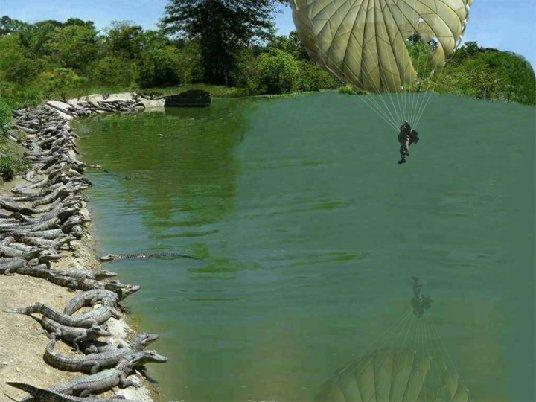
How Was My First Time Parachuting?

It Was OK.

Well, Actually It Wasn't So Great.
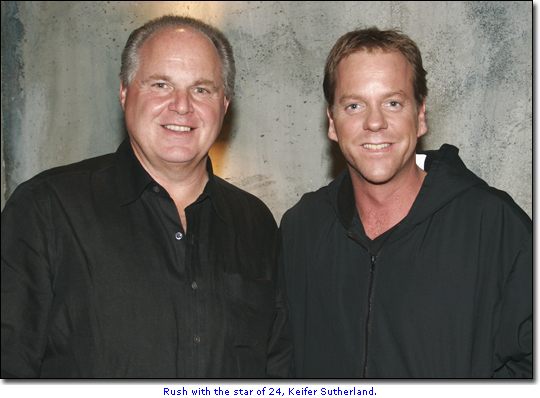
Jack Bauer and Rush

How cool is that!
(just had to post this again :-)


Ann Coulter Checking In

NY Times, Broken Clock: Both Occasionally Right
By
Ann Coulter

The New York Times has been urgently warning Congressional Republicans to abandon the Iraq War or face ruination in the November elections. Of course, for three years now, the Times has predicted that all world leaders who supported the war would be thrown out of office on their ears.

However embattled they are, I don't think Republicans are at the point of taking advice from the mainstream media, but let's look at the facts.

Four major world leaders who sent troops to Iraq have faced elections since the war's inception -- Jose Maria Aznar in Spain, John Howard in Australia, Tony Blair in Britain and Junichiro Koizumi in Japan. Three of them won re-elections in campaigns that centered on their support for the Iraq war.

Only in Spain did voters capitulate to savagery and vote in an al-Qaida-friendly government in response to their trains being bombed the week before the election. Unaware that there is NO CONNECTION between al-Qaida and Iraq, al-Qaida's European spokesman explained that the terrorist attack was intended to punish Spain for supporting the Iraq war. Spanish voters duly complied, making terrorist attacks in the rest of the world more likely. Muchas gracias, Spano-weenies.

But in the three other elections, Iraq war-supporting prime ministers won historic victories. During the run-up to each of these elections, The New York Times described them as referendums on the war and predicted defeat for any leader who had supported war in Iraq. Only when the war-supporting leaders won did the Times change its mind and decide these elections were really about the economy, privatizing the post office, Tony Blair's tie, "The Sopranos" -- anything but the war.

In the run-up to Australian Prime Minister Howard's re-election, the Times noted that he had "made the alliance with Washington a key element of his tenure." The Times was hopeful that Australia would be as pathetic as Spain, noting that "with al-Qaida threatening reprisals for the country's support of the United States in Iraq -- a war that most Australians opposed -- is Australia poised to become the next Spain? Will it become the next country to abandon President Bush?"

On the eve of Howard's re-election bid in October 2004, the Times ran an article titled: "War in Iraq Plays a Role in Elections in Australia," saying Howard's opponents promised to "have the troops home by Christmas."

When Howard walloped the opposition in the election a few days later, becoming only the third prime minister of Australia ever to be elected to a fourth term, the Times headline was: "Australians Re-Elect Howard As Economy Trumps the War."

As Blair approached British elections in April 2005, the Times ran an article titled: "With 10 Days to British Vote, War Emerges as Top Issue." As the Times cheerfully reminded its readers: "The prospect of war drew huge street protests here in early 2003, and in the aftermath Mr. Blair was -- and is still is -- accused by many people of misleading Britons about the legality and the rationale for the invasion." The war had "damaged Mr. Blair's credibility and left many Britons mistrustful of him."

The Times cited "many Britons" who said "their vote will be swayed by the fact that, while Mr. Blair spoke so forcefully of a threat from Iraqi unconventional weapons, none were ever found."

And then Blair went on to win the election, becoming the first Labor Party candidate to win a third term in the party's 100-year history. It was almost as if "many other Britons" believed in the cause the British military was fighting for in Iraq! The Times took solace in the fact that his margin was lower than in previous elections -- "reflecting his unpopularity over the war in Iraq."

One year before elections in Japan, the Times was predicting defeat for Koizumi, a loyal friend to President Bush and an implacable supporter of the war in Iraq.

Reporting on the unpopularity of the Iraq War in Japan, the Times said "polls indicate that the population is against an extension" of Japanese troops serving in Iraq and that the opposition vowed to withdraw troops. Indeed, "some members of Prime Minister Junichiro Koizumi's own party have been calling for the troops' withdrawal."

And then in September 2005, Koizumi's party won a landslide. The Times described this as mainly a victory for the prime minister's idea to privatize the post office, explaining that Koizumi had won "by making postal privatization -- an arcane issue little understood by most voters -- a litmus test for reform," thus confirming the age-old political truism, "Most elections hinge on arcane, obscure issues voters don't know or care about."

As congressional Republicans decide whether to take the Times' advice and back away from the war this election year, they might reflect on a fourth world leader who won re-election while supporting the Iraq war. Just about four months before Bush was re-elected in 2004, the Times put this on its front page: "President Bush's job approval rating has fallen to the lowest level of his presidency, according to the latest New York Times/CBS News poll. The poll found Americans stiffening their opposition to the Iraq war, worried that the invasion could invite domestic terrorist attacks."

Maybe it was his support for the post office.

Copyright 2006 Ann Coulter


I (Don't) Want to Hold Your Hand

Here's a funny story (funny to me at least) of the spat between Apple Computer and Apple Records regarding iTunes.

I love the line towards the end of the story: Apple Records felt that Apple Computer's getting into the music distribution business with its iTunes service violated their agreement -- and the final straw for them was when Apple approached them for permission to sell Beatles songs via iTunes!

The other part I find interesting is how technology tends to outpace the contracts and agreements we make. Apple Records and Apple Computer had a deal. Records would stay in the music business and Computers would stay in the computer business. This deal was made years before the web and the concept of digitized music being downloaded over the internet and being played on computers. Who'd a thunk it!


Beatles' Record Label
Wants Apple to Change
Logo on iTunes Product

By AARON O. PATRICK
March 30, 2006; Page B3

LONDON – Playing a 1970s disco hit to illustrate his point, a lawyer for the Beatles' record company asked a British court to order Apple Computer Inc. to stop using the Apple logo to promote its iTunes music store.

Geoffrey Vos, a lawyer for the Beatles' Apple Corps, told England's High Court that Apple Computer had engaged in a "flagrant violation" of an agreement the two sides had previously reached over use of the Apple name and logo.

The case could settle a long-running flap between the companies over use of the Apple brand name. In 1991, after more than 100 days in court, the companies agreed to share use of the name. Apple Computer, of Cupertino, Calif., was allowed to use the brand for computers as well as for equipment and software to distribute music. London's Apple Corps had the right to use it to produce and sell music.

Then Apple began promoting its iTunes service, a popular computer program that allows people to download songs from the Internet and transfer them to Apple's iPod portable music players. The Beatles' company argued in court that iTunes violated the agreement by placing the Apple logo on the program and in advertisements for it.

The case requires the judge, Edward Mann, to interpret an agreement over the sale and distribution of music that was written before the phrase "music download" came into existence. Apple Computer is scheduled to begin laying out its case today. The hearing is expected to end next week.

The case is likely to hinge on whether Apple Computer is found to be packaging and selling music or merely distributing it. Mr. Vos cited examples that he said showed Apple had eagerly entered the music industry, including paying for recording sessions for singers Elvis Costello and P.J. Harvey. He presented technical information about the ability of the iTunes program to alter song formats, which he said proved Apple was more than a music distributor.

"What they want now is to be in the music business," Mr. Vos told the court. "Which is okay as long as they use a name that is unrelated [to Apple]."

To show how the iTunes store works, Mr. Vos downloaded a track during yesterday's hearing. He played part of the song "Le Freak," by '70s band Chic.

The Beatles' company wants the judge to find that Apple Computer is in breach of their 1991 deal and to order Apple to stop using its logo on the program and in iTunes advertisements. If Apple Computer is found to have violated the agreement, the Beatles' company would be able to seek damages. The iTunes service wouldn't be shut down.

The companies have discussed the matter for years. In January 2003, Apple Computer asked Apple Corps to put Beatles' songs on the iTunes service. The Beatles' company, unhappy with Apple Computer's move into music, refused. Two months later, Apple Computer Chief Executive Steve Jobs offered to buy the name Apple Records for $1 million, Mr. Vos said. The Beatles' company rejected the offer. The band's songs still aren't among the 3.6 million offered on iTunes.

Rush and Jack Bauer

how cool is that!

Wednesday, March 29, 2006

"It was murder in the eyes of God"

Open Letter to Michael Schiavo

3/25/2006 8:38:00 PM


WASHINGTON, March 25 /U.S. Newswire/ -- Fr. Frank Pavone, national director of Priests for Life, and an eyewitness to Terri Schiavo's final hours, released the following open letter to Michael Schiavo tonight. Fr. Pavone will read it to a worldwide audience on an internationally broadcast religious service on Sunday morning, March 26:

A year ago this week, I stood by the bedside of the woman you married and promised to love in good times and bad, in sickness and health. She was enduring a very bad time, because she hadn't been given food or drink in nearly two weeks. And you were the one insisting that she continue to be deprived of food and water, right up to her death. I watched her face for hours on end, right up to moments before her last breath. Her death was not peaceful, nor was it beautiful. If you saw her too, and noticed what her eyes were doing, you know that to describe her last agony as peaceful is a lie.

This week, tens of millions of Americans will remember those agonizing days last year, and will scratch their heads trying to figure out why you didn't simply let Terri's mom, dad, and siblings take care of her, as they were willing to do. They offered you, again and again, the option to simply let them care for Terri, without asking anything of you. But you refused and continued to insist that Terri's feeding be stopped. She had no terminal illness. She was simply a disabled woman who needed extra care that you weren't willing to give.

I speak to you today on behalf of the tens of millions of Americans who still wonder why. I speak to you today to express their anger, their dismay, their outraged astonishment at your behavior in the midst of this tragedy. Most people will wonder about these questions in silence, but as one of only a few people who were eyewitnesses to Terri's dehydration, I have to speak.

I have spoken to you before, not in person, but through mass media. Before Terri's feeding tube was removed for the last time, I appealed to you with respect, asking you not to continue on the road you were pursuing, urging you to reconsider your decisions, in the light of the damage you were doing. I invited you to talk. But you did not respond.

Then, after Terri died, I called her death a killing, and I called you a murderer because you knew -- as we all did -- that ceasing to feed Terri would kill her. We watched, but you had the power to save her. Her life was in your hands, but you threw it away, with the willing cooperation of attorneys and judges who were as heartless as you were. Some have demanded that I apologize to you for calling you a murderer. Not only will I not apologize, I will repeat it again. Your decision to have Terri dehydrated to death was a decision to kill her. It doesn't matter if Judge Greer said it was legal. No judge, no court, no power on earth can legitimize what you did. It makes no difference if what you did was legal in the eyes of men; it was murder in the eyes of God and of millions of your fellow Americans and countless more around the world. You are the one who owes all of us an apology.

Your actions offend us. Not only have you killed Terri and deeply wounded her family, but you have disgraced our nation, betrayed the Gospel of Jesus Christ, and undermined the principles that hold us together as a civilized society. You have offended those who struggle on a daily basis to care for loved ones who are dying, and who sometimes have to make the very legitimate decision to discontinue futile treatment. You have offended them by trying to confuse Terri's circumstances with theirs. Terri's case was not one of judging treatment to be worthless -- which is sometimes the case; rather, it was about judging a life to be worthless, which is never the case.

You have made your mark on history, but sadly, it is an ugly stain. In the name of millions around the world, I call on you today to embrace a life of repentance, and to ask forgiveness from the Lord, who holds the lives of each of us in His hands.

-- Fr. Frank Pavone

Priests for Life is the nation's largest Catholic pro-life organization dedicated to ending abortion and euthanasia. For more information, visit http://www.priestsforlife.org.

Psalm 23

The King James version of this Psalm is the best. Moreover, is it possible to "exhaust" this Psalm? I mean, I can read it again and again and it is just as fresh and powerful the last time as the first.

The LORD is my shepherd; I shall not want.

He maketh me to lie down in green pastures: he leadeth me beside the still waters.

He restoreth my soul: he leadeth me in the paths of righteousness for his name's sake. Yea, though I walk through the valley of the shadow of death, I will fear no evil: for thou art with me; thy rod and thy staff they comfort me.

Thou preparest a table before me in the presence of mine enemies: thou anointest my head with oil; my cup runneth over.

Surely goodness and mercy shall follow me all the days of my life: and I will dwell in the house of the LORD for ever.

Tuesday, March 28, 2006

Crisis Over

Apple Store
Shipment Notification

Hello Richard Ryan,

We wanted to let you know that your order has shipped. If you ordered multiple items, you may receive separate shipments with no additional shipping charges. An invoice for your shipped products will be emailed to you shortly. Visit Order Status to review your order at any time.

Best regards,
The Apple Store Team

Order Number:
W200997

Order Date:
MAR 27, 2006

Shipment Information

Shipment Date:
MAR 27, 2006

Estimated Delivered By:
MAR 31, 2006

Shipping Address:
Richard Ryan
123 Main Street
whoville, IL 60010
(847) 555-0861

Carrier Name:
FED EX GROUND

Tracking Number(s):
0057945785781

All shipments except those delivered by the U.S. Postal Service require a signature on receipt. The name of your carrier is listed with the shipment information above.

Tracking information may not be immediately available. U.S. Postal Service and other carriers may not provide tracking information. If you have questions about this shipment, please read Frequently Asked Questions about shipping.


Shipment Details

Product Name


Product Number

Qty

Subtotal

REFURB IPOD W/CLICK WHEEL 40GB W/DOCUSA

F9268LL/A

1

$219.00

Additional Information

For order status and answers to questions, please visit Customer Service online. Or call 1-800-676-2775, Mon-Fri 7 a.m.-10 p.m., Sat-Sun 9 a.m.-6 p.m. CT. Please have your Order Number available.

Get the latest news right from the source. Subscribe to Apple's free newsletters and find out about the latest products from Apple and its partners, plus special deals and much more.

Purchase Order Number:
84752608

Delivery Time Frames

Standard Shipping

Allow five business days for delivery.

Delivery Note:
All shipments except those delivered by the U.S. Postal Service require a signature on receipt.

2-Day Shipping

Products shipped before 5:00 p.m. EST are normally delivered by 4:30 p.m. local time two business days after shipment.

2-3 Day International Shipping

Products shipped before 5:00 p.m. EST are normally delivered by 4:30 p.m. local time two to three business days after shipment.

Overnight Delivery

Products shipped before 5:00 p.m. EST are normally delivered by 3:00 p.m. local time one business day after shipment.

Overnight delivery is not available for orders shipped to Alaska and Hawaii.

Please do not reply to this email message.
It was sent from an address that cannot accept incoming email.

You can also order from the Apple Store by calling 1-800-MY-APPLE (1-800-692-7753).
This order is subject to Apple's Sales and Refunds Policies. | Privacy Policy
Copyright © 2006 Apple Computer, Inc. All rights reserved.

Monday, March 27, 2006


Life Without iPod -- Is There?


:-(

Saturday, March 25, 2006

This Tiger Wanted to be a seal -- as in SEAL
(saw this via Froggy Ruminations)

Tiger Woods Visits Naval Special Warfare

Blackanthem Military News, CORONADO, Calif., February 01, 2006 13:35

Pro golfer Tiger Woods viewing a static display of various SEAL weaponry. Tiger was in San Diego for the Buick Invitational Golf Tournament and spent the afternoon learning about the Special Operations Community. Photo courtesy of U.S. Navy

Pro golfer Tiger Woods visited the men and women of Naval Special Warfare Jan. 23 to tour their facilities and learn more about their mission.

Woods was in town for the Buick Invitational at Torrey Pines, in which he is the defending champion, and wanted to see some of the Navy’s champion SEALs and Special Warfare Combatant-craft Crewmen (SWCC). The visit gave him a glimpse into the training and capabilities of the Navy’s finest warriors.

Woods learned about SEAL training and the various weapons they use, and then addressed Sailors who were preparing to enter the SEAL training program.

"If I hand’t been in golf, I would have been here with you guys" said Woods. "When I was younger, I always dreamed of being a Navy SEAL."

The class responded with the traditional Naval Special Warfare "Hooyah!" cheer.

"My mom was Asian, so she was disciplined," Woods said. "My father, being former military, was also very disciplined. I was very lucky," said Woods. "I wouldn’t have had the discipline to succeed in my sport if not for my upbringing."

Woods’ visit concluded with a demonstration of the high-speed boats used by the SWCC operators.

"I really admire what you’re doing for your country," Woods said, "and that you’re going to be out there protecting our freedom."


By Petty Officer 3rd Class Christopher Menzie / Naval Special Warfare Public Affairs

Followers

Blog Archive